• Home
  • Interviews
  • News & Views
  • Wine in India
  • Wine Society
  • Food and Wine
  • Winery Visits
  • Guest Column
  • Contact
  • Home
  • Interviews
  • News & Views
  • Wine in India
  • Spirits
  • Food & Wine
  • Winery Visits
  • Guest Column
  • Contact
  • March 25, 2026

    Michel Rolland’s India connection

  • February 8, 2026

    When the walls whisper of the terroir

  • October 9, 2025

    Glass Act: Shiva pours to win

  • July 15, 2025

    So, no/low drinks aren’t a no-no!

  • June 4, 2025

    ‘Canned and non-alcoholic sparkling wines are growing in popularity’

  • April 14, 2025

    Beyond the Barrel: Journey Through Burgundy’s Hidden Gems

  • February 21, 2025

    Emotional journeys & sensory mastery: BTS at the Best Sommelier of India 2025

  • February 21, 2025

    Best Sommelier of India: Meet the Final Five

  • November 5, 2024

    ‘Portuguese native grapes give the country the tools needed against climate change’

  • October 31, 2024

    Women in Wine Portugal: “The wine business is alll about relationships”

  • August 31, 2024

    A Master Sommelier’s story: Beaucastel & beyond

  • June 28, 2024

    Riesling Love: The passion of Dr Lippold

  • April 30, 2024

    Rosé: no longer just a happy summer sip

  • March 25, 2024

    The Gerard Basset Foundation: wine education scholarships for India

  • February 29, 2024

    Wine regions to visit in 2024

  • December 21, 2023

    48 hours of wine euphoria in Mumbai

The rise and rise of the volcanic wines of Etna
June 17, 2021

Trend-spotting series I: Wines of Mount Etna

Occasionally, there comes a trend that becomes more than just a trend. The growing appreciation for the wines of Mount Etna in Sicily, the large island south of Italy, is one such, with the last twenty years seeing a deepening appreciation for its wines made from unique indigenous grapes grown in the rich volcanic soils of an active volcano.

In this article, I explore the typical viticulture and winemaking of Etna DOC, an appellation in Sicily that has rapidly become a favourite of wine lovers and experts alike, featuring in top restaurant wine lists around the world. This is based on the story of one of the region’s winemakers.

The volcanic wines of Sicily’s Mount Etna

To understand what makes the wines of Etna so unique today, it is necessary to dip into its past.

Winemaking in Sicily is no modern phenomenon, tracing back to the Greeks who brought their viticultural and winemaking practises to the land in the 8th century BC or even before.

The old palmento at Vigneti Vecchio, Mount Etna in the background

Always known for its temperate, sunny climate and ability to produce plentiful quantities of ripe grapes, its transition into a region known for its bulk production of wine and must was the natural next step. These bulk wines were then shipped to cooler regions in Europe to add body and structure to wines made there. Ergo, while quantities of wines produced were large, quality was never a prime focus.

This began to change in the the 1980s when the family estate of Planeta, along with major producers like Donafugata and Tasca d’Almerita re-focused attention on Sicily by producing a range of wines made to high standards from international grape varieties. Over time and aided by subsidies from the European Union, Sicilian wine established itself, and the focus shifted to better quality and its range of unique varieties including Nero d’Avola (black) and Grillo (white).

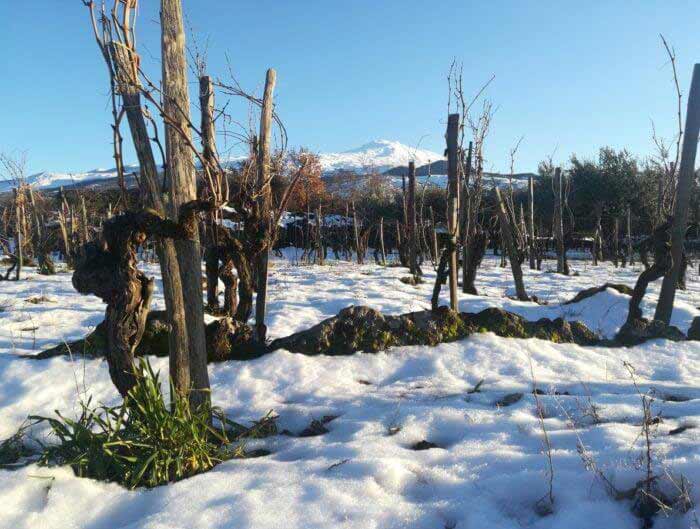
Enter the wines of Etna DOC, the appellation based on the slopes of Mount Etna. Here, Nerello Mascalese (the hero grape of the region, often compared to Nebbiolo for its pale colour, high acidity and distinct tannins), Frappato, Nerello Cappuccio, Carricante (a high acid, ageworthy white) and Cataratto among others, grow at heights up to 1300 metres above sea level on a variety of diverse rich dark lava flow soils. There is strong sunshine reflecting off the Mediterranean Sea which is moderated by altitude, enabling excellent ripening of grapes and concentration of flavours. The climate is Mediterranean, with adequate rainfall for viticulture – about 1000 mm mainly in autumn and winter. Viticultural areas are divided into terroir-specific sites (akin to the climats of Burgundy) known as contrade, of which there are approximately 140. The layers of lava over the years have created a mosaic of unique terroirs so no single contrada is like the other.

Already, you can see why Etna’s vineyards differ from others around Sicily or indeed, mainland Italy.

The story of the family Vecchio

There are already several notable producers making wines in Etna DOC. (see footnote). For this article, I am focusing on the story of Carmelo and Rosa Vecchio, small producers with strong ties to the land who produce about 12,000 bottles annually under the label of Vigneti Vecchio. Over Zoom, Rosa explains their story to me. “My husband, Carmelo, has lived here for many generations – working for land-owning noblemen for centuries as sharecroppers and labour lenders – and only from the 1970s as landowners. In 1970, in fact, the noble Camarda family decided to sell the great fief of Carranchello near the Verzella hamlet of the municipality of Castiglione di Sicilia, which Carmelo Vecchio (grandfather and namesake of the current owner Carmelo) bought.” In 1997, Carmelo’s grandfather died and the land was divided within the family. “It was a little piece of land with plenty of biodiversities – olive trees, fruit trees, vegetable gardens – and a palmento. The wine made here was sold in bulk to other parts of Europe.”

Late into the last century many of Etna’s vineyards were abandoned as farmers migrated to the cities to make an easier livelihood. But the Vecchio family stayed on, working the land, making their wine.

  • Carmelo and Rosa
  • Carmelo Vecchio in his vineyards

But this wine was not the wine the Vecchios make today. Rosa explained, “Because Sicilian wine was always sold in bulk and used for blending, to give body, structure, and alcohol to the noblest wines of northern Italy and Europe, there have always been many good grape growers but no local winemakers. The farmer’s work, therefore, ended at the palmento, where our grapes were crushed, de-stemmed in our beautiful lava-stone millstones, the must then loaded onto special wagons and taken to the port of Etna where it was loaded onto the ships to send onwards. In fact, Nerello Mascalese produces a very clear must with a high alcohol content that is well suited to long journeys by sea.”

The last few decades have seen a handful of intrepid winemakers brave the altitude and lava ash (the last eruption was as recent as March 2021) in order to plant grapes to make their own unique expressions of Etna wines. However, the gamechanger for Carmelo was his winemaking experience of 18 years with pioneering winemaker Andrea Franchetti, who made wines at Passopisciaro. In 2016, the Vecchios decided to branch out and make wine from their own plots of old vines (some as old as 120 years), setting up a small winery in their garage in Solicchiata in the town of Castiglione di Sicilia. Their grapes are hand-harvested, made using ambient yeast and without fining or filtering. The wine is fermented in 500-litre older barrels.

“The aim was to vinify and bottle our grapes, producing a wine that is a personal and unique expression  of Etna from the vineyard to the bottling,” Rosa tells me, “We decided we wanted to work this way, focusing on the unique terroir of each parcel.” The work is far from easy, as their vineyards are fragmented due to the topography of the region – the biggest being two hectares. Work in the vineyards is entirely by hand, as is harvest.

The Vecchios currently make four wines: Sciare Vive Rosso (about 5000 bottles), Sciare Vive Bianco (about 4000 bottles), Donna Bianca (about 1000 bottles), Contrada Crasà (about 2000 bottles).  The interest in white Etna wine (Bianco) is a recent phenomenon, adds Rosa, only about 20 years or so. The Vecchios planted their own white grapes as recently as 2019, buying in prior to that. While the region has always grown white grapes varieties (Carricante, Catarratto, Minnella, Grecanico, Inzolia) and there are many old vines in the area, these have been traditionally used to blend (5 to 10%) in Etna Rosso (red) and not to make white blends or varietal wines, as is done now.

Dark, rich volcanic soils: ‘Sciare’ means lava flow, explains Rosa, while ‘vive’ means life. “People associate volcanic lava with death and destruction but it gives us life.”

Over time, as their reputation grew, the demand for their wines increased and their small garage winery became too small. In addition, in 2019-20, they also bought ‘new’ old vines and added new vineyards. “So, in 2020 we decided to build a 400 sq m large new cellar not far from our vineyards where we can also host the many wine enthusiasts and visitors who would like to visit us.” While the new winery and tasting room will only be ready for visitors later in the year owing to the pandemic, the Vecchio focus will always remain on small production and family ownership, Rosa insists. Their clientele remains niche, engaged wine lovers with a focused interest in boutique wineries and indigenous grapes.

Climate change and Etna

Climate change has not spared Etna, and harvest is earlier of late. “We have seen major changes in the last 10 years,’ says Rosa, “In 2017, we harvested white grapes in August, as temperatures rose to over 36 degrees C and we were worried we might lose our vines in the heat. This year it was the opposite – ripening is steady and we are happy.”

The uncertainty of climate change notwithstanding, Rosa is excited about a special project they are nurturing: in 2020 they hand-harvested and de-stemmed their Nerello Mascalese, fermenting it with 5% white grapes, using ambient yeast and only free-run juice. “We are waiting to see how this wine develops,” she says, smiling.

“To us, it is but yet another piece that we will add to our extraordinary parable of work and life here on Etna, where we have had the privilege of being born, and we hope to stay in to raise our vines, our project, our daughters.”

Harvest at Vigneti Vecchio, Etna

Contact: https://www.facebook.com/vignetivecchio

Vigneti Vecchio wines are distributed in Australia, Canada, Denmark, France, Japan, UK, Italy, Russia, USA

——————————————————————————————————————

Main DOCs of Mount Etna:
Etna Rosso: minimum 80% Nerello Mascalese, maximum 20% Nerello Cappuccio
Etna Bianco: minimum 60% Carricante
Etna also has an appellation for rose (Etna Rosato) and sparkling wine (Etna Spumante)

Other top Etna producers with wines to look out for:

  • Tenuta delle Terre Nere
    http://www.tenutaterrenere.com/en/index.php
  • Passopisciaro – Andrea Francetti
    https://www.vinifranchetti.com/passopisciaro/winemaking-on-mt-etna
  • Benanti winery
    https://www.benanti.it/en
  • Tasca d’Almerita
    https://www.tascadalmerita.it/en/estate/tascante
  • Graci wines
    https://www.bbr.com/producer-1844-graci-sicily

Share
Read More
No Comment

Interviews  / Trend-spotting


Brancaia: Renaissance and Reformation in Tuscany
February 28, 2021

Read More
No Comment

Brancaia: Tuscany’s true Blu at 40
January 31, 2021

Read More
No Comment

Mulled wine launch, big barrel buys…
December 18, 2020

Read More
No Comment

Chablis: the triumph of terroir
November 30, 2020

Read More
No Comment

‘A gateway to the world of wine’: TiLT, Kapil Sekhri’s final dream
October 19, 2020

Read More
No Comment

‘Can’ it work? The canned wine trend sweeping the world – Part 1
September 29, 2020

Read More
No Comment

Rosé: A lighter shade of pale
August 30, 2020

Read More
No Comment

Newer Posts Older Posts

  • About Ruma

    About Ruma Singh

    After over a decade as a journalist with one of India’s top newspaper groups in New Delhi and then Bangalore.. Read More

  • Latest News

    Can emerging markets for wine and spirits save the day? (Yes, we can!)
    90,000 visitors at Vinitaly 2026
    Forbes Wine: a new content vertical to launch
    Read More News
  • See Events Diary
  • Ruma’s articles in other media

    Reading News Paper

    A selection of articles by Ruma which have appeared in other publications..

    Read More
  • Subscribe To
    My Free Newsletter


  • Listed #69 Among the World's
    Top 100 Wine Websites.

    Feed spot
  • Follow Ruma Singh on Instagram


    Follow Ruma on Instagram

  • Italian Wine Podcast

    Harshal Shah and Ruma Singh DipWSET

    Italian Wine Podcast
  • Wine Expo 2023
  • Facebook

  • Free Subscription


  • Latest Posts

    • Michel Rolland’s India connection
    • When the walls whisper of the terroir
    • Glass Act: Shiva pours to win
    • So, no/low drinks aren’t a no-no!
    • ‘Canned and non-alcoholic sparkling wines are growing in popularity’
    • Beyond the Barrel: Journey Through Burgundy’s Hidden Gems
    • Emotional journeys & sensory mastery: BTS at the Best Sommelier of India 2025
    • Best Sommelier of India: Meet the Final Five
  • Popular Posts

    Popular Posts

    • ‘Tis the season for...
    • Read, say, love WINE: win...
    • The KRSMA story: from Ham...
    • The Maltese Cross and the...

Copyright © rumasingh.com | Media | Sitemap | Login