Trendspotting Series II: Orange wine
This continues the series of wine trends which are more than mere trends. I look into the very popular orange wine trend, tracing it to its home in Friuli, the home of the Paraschos family who is committed to making natural wines.
Many readers would know that orange wine is not made from oranges. Nor, in many cases, is it even orange in colour: more often a rich amber or gold. In fact, orange or amber wine is made from white grapes that take on a deeper hue via skin contact (from grape stems, skins) during fermentation, so the term skin-contact wine is more accurate. It is also not a new creation although has become a modern trend. It is old. Very old.
Orange wine was first chronicled 8000 years ago in Georgia, the country known as the cradle of wine. Here, the wine was traditionally vinified in qvevri or large terracotta clay amphorae, where whole bunches of grapes (Rkatsiteli, Khikhvi, Saperavi and Kisi among many others), were left to macerate in the wine. The qvevri was then buried underground and the wine was left to mature. The skin, seeds and stalks (typically removed during white winemaking these days) imparted a deeper colour and tannins to the final wine. Ergo, the wine produced was often more red-wine in style and production method, with a deeper colour, savoury in flavour and textured on the palate.
Today, skin-contact wines are beloved of many sommeliers and wine experts for their complexity and structure and are often found on natural wine bar lists. They are also produced around the world, especially noteworthy being those made in Slovenia, Greece and in Friuli-Venezia-Giulia in northeastern Italy, besides quickly gaining popularity in the New World. In Friuli, a region renowned for its white wines, icon winemakers Josko Gravner and Stanko Radikon were among the first to turn their back on conventional winemaking, going back to methods of production that include use of ambient yeast, no sulphur dioxide, fining or filtration.
Today’s story is about a boutique winery in the sunny, undulating hills of Collio DOC, a prestigious wine region located in Friuli’s Gorizia province, where a passionate family gave up their established business to make high-quality skin contact natural wines.
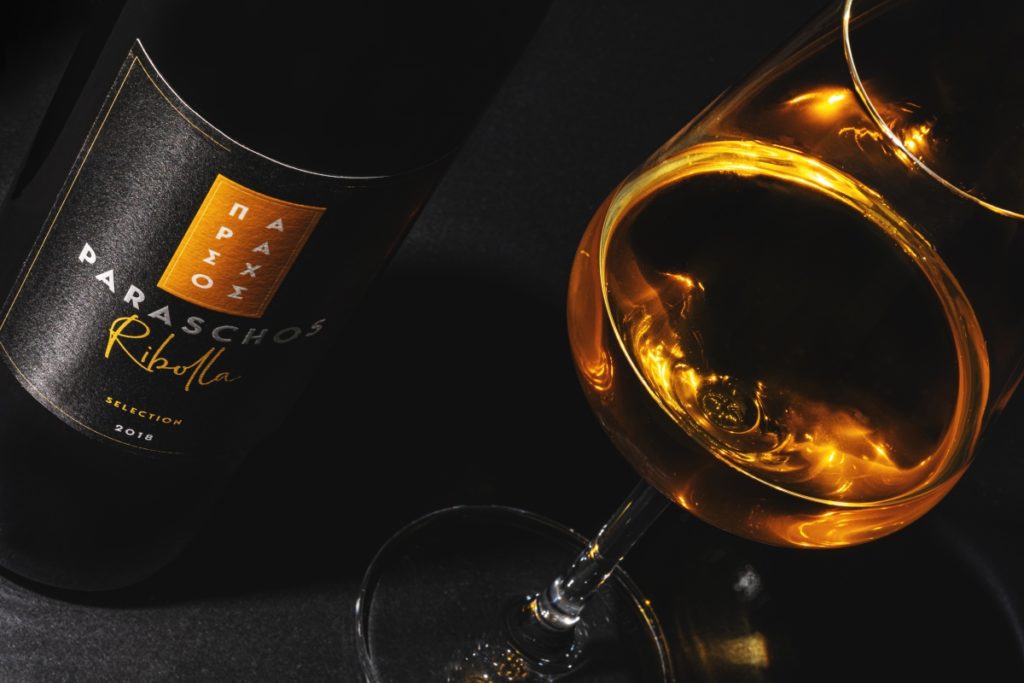
Paraschos’ Ribolla Gialla
The Parachos Story
The Paraschos family were not vintners by tradition. When Evangelos Paraschos moved from his native Greece to Italy, he started a small pharmaceutical business. It was at Evangelos’ wife’s family-owned restaurant that his focus turned to wine. Here, in the 1980s when natural or organic winemaking was not even a trend, the restaurant wine list already featured natural, skin-contact wines including wines by Gravner and Radikon, upcoming producers at the time.
No wonder then that Alexis Paraschos, second-generation winemaker of Paraschos, grew up drinking natural wine made from native Collio grapes. “I was 18 years old when Paraschos started – so it was the only type of wine I knew. Later, when I discovered so-called conventionally-made wines, I found them heavy on the digestive system.”
The Gravner influence: natural winemaking
The Paraschos’ neighbour was Gravner and his influence on them was marked from the beginning. “Josko Gravner was my father’s age and believed strongly in natural winemaking. To him, this was the only way to make wine, no other way existed.” Gravner became famous but his thinking and approach has remained unchanged, said Alexis. Evangelos loved the way the natural winemakers grew their vines without pesticides or herbicides, and he loved the wines that were produced from these vines. “With time, it grew into an obsession with skin-contact wines.”
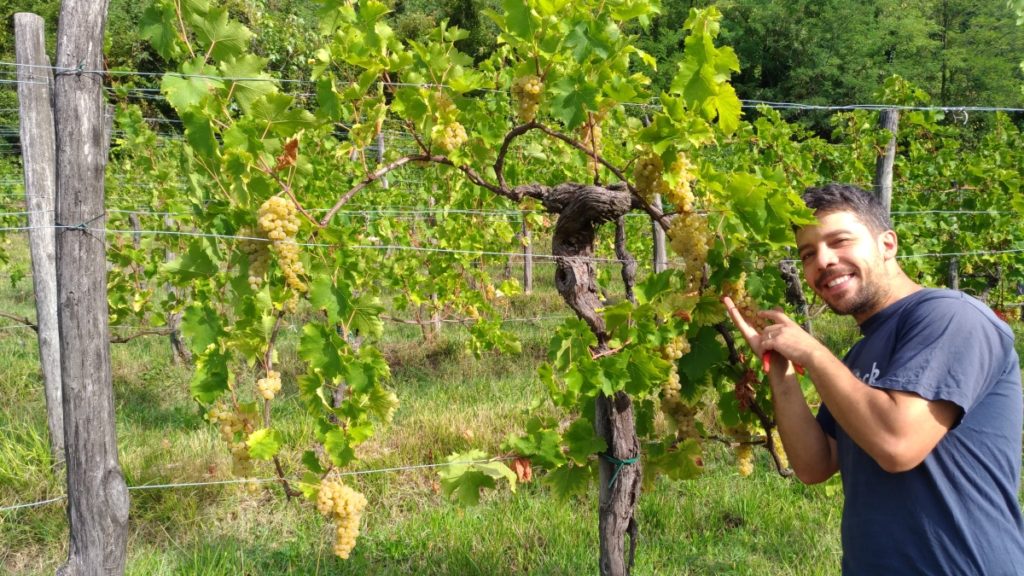
Alexis Paraschos with his Friulano (Sauvignonasse) vines
Paraschos decided to practise organic viticulture right from the start – the grapes were initially grown organically though the wines were produced by conventional methods. The bottlings were small, initially vinified in their own garage and sold directly – there was no space to store the bottles beyond that year’s production. In 2003, they built a new cellar and began experimenting with short maceration on skins and spontaneous fermentation. Today, they produce around 30,000 bottles and 10 labels.
Local grapes rule
With natural winemaking, tight control on quality and yield is essential, says Alexis. “We harvest by hand, yes, but the selection is extremely rigorous. We can’t afford any bad grapes in the winery.” Their seven hectares of vineyard (now 10 ha) is dominated by local white grapes Ribolla Gialla, Friulano (aka Sauvignonasse) and Malvasia Istriana along with Pinot Grigio and Chardonnay. They also have 100-year-old Merlot vines which Alexis is particularly passionate about. Merlot is not just any ‘international variety’, he points out, but very much part of the region’s history – Napoleon first introduced it into the region and after World War II it became Gorizia’s main red grape – the only black grape to survive in the region. The vineyards themselves face different aspects – the Alps, the Mediterranean and the plains of eastern Europe – allowing for a variety of grapes and styles of wine to be produced.
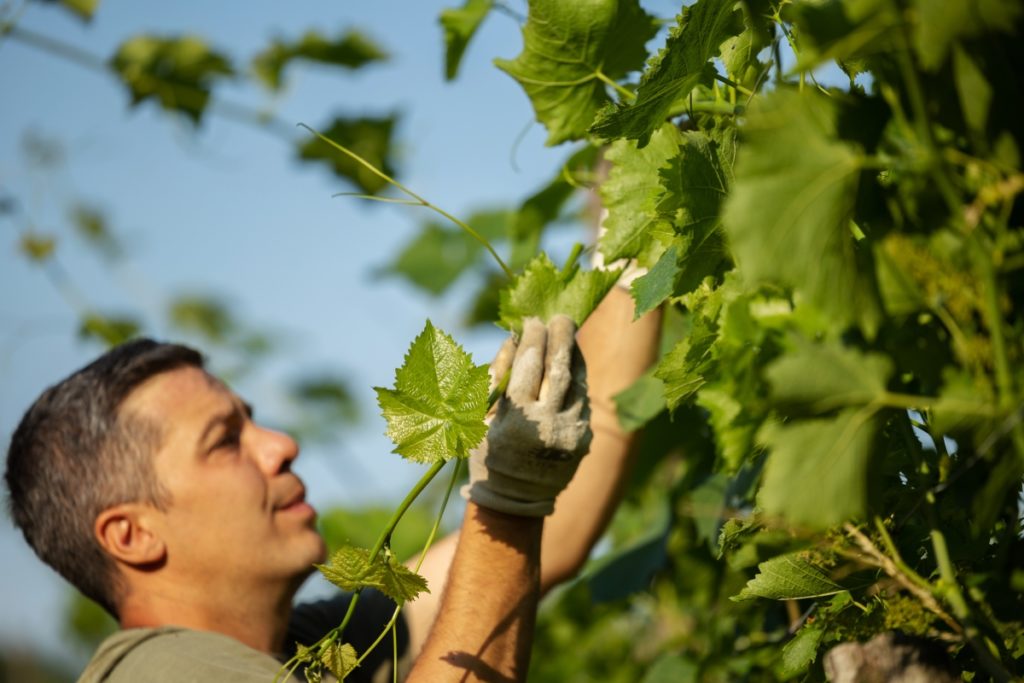
Old vines, ancient soils, perfect terroir
Alexis dives into the region’s difficult history. Friuli-Venezia-Giulia, bordered by Slovenia and Austria, faced devastation first from the phylloxera outbreak in the late 19th century and then was shredded by bombs during the world wars. As a result, most vineyards were decimated. “Only a few, hidden areas remained intact,” explains Alexis, “So we are very proud of our old vines. In 2001 and 2003 we planted new vines from the old using selection massale – you can see the difference in the yields and sizes of the grapes. Now, 20 years later, our ‘young puppies’ are growing well, showing good balance and acidity.”
Unique to the region and in no small way responsible for the quality of its wine is the mineral-rich soil. Flysch or ‘ponca’ as it is locally known, is typical of the pre-Alpine region: calcareous clay or marl layered with hard sandstone from an age when the land was covered by the ocean.“Our region is also rich in clay and this combination allows perfect drainage (of water) – ideal for skin-contact wines. Every vintage we get ripe tannins and phenolic maturity, so it is possible to macerate all our varieties on skins. The warm nights help grapes ripen fast so if you choose your harvest time, potential alcohol may be 12% to 15%. This region is perfect for viticulture.”
Skin contact adds complexity
Earlier, the harvested grapes were macerated for up to 8 days in open-topped vats before amphorae became commonplace. The wines were matured for 1-2 years in a range of different wooden casks – cherry, acacia, chestnut, Slavonian. Today, oak is the norm. Paraschos introduced amphorae in 2009 for a selection of their grapes, typically Malvasia. For this, “We macerate the grapes on skins for months, even up to a year in amphorae, which are first open, then sealed. Only 1000-2000 bottles are made.”
Skin-contact winemaking is no fad, avers Alexis. “It is here to stay – it offers only positives. With time, the market will decide what makes sense – including the price – and things will get levelled out in time.”
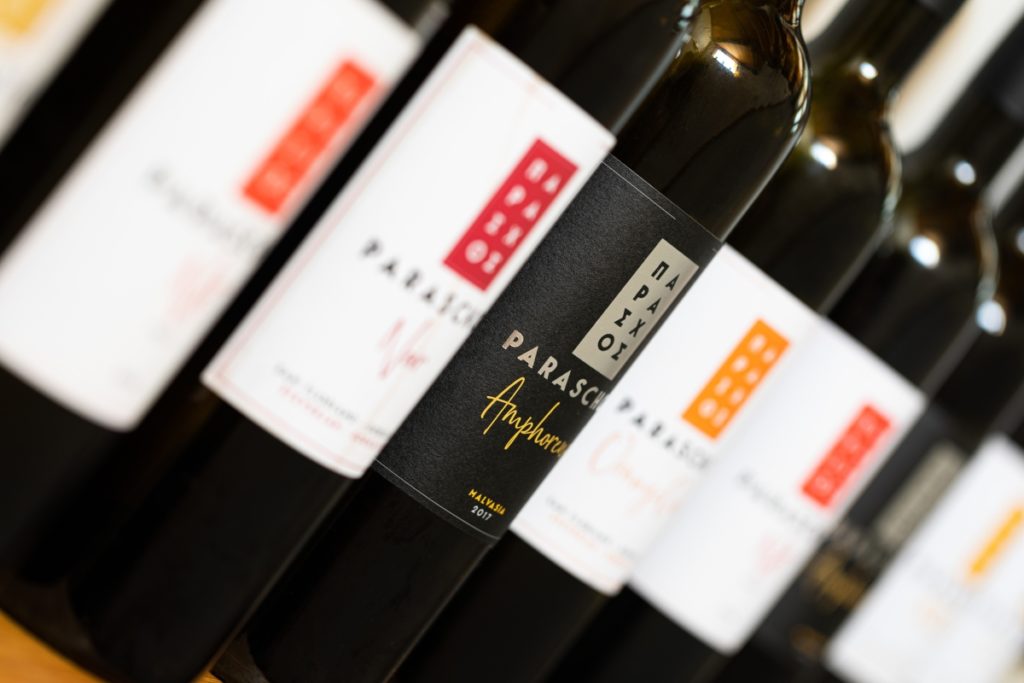
The Paraschos wine portfolio
He adds, “Orange wine has much more to it than just colour. It is expressive on the palate. It offers body, structure, tannins and complexity of mouthfeel.” (I can vouch for the fact that orange wines are food wines through and through – Ed).
I ask Alexis if he has any favourite food pairings with his wines. He pauses and smiles. “We live in an area where there are so many different cuisines and cultural influences. At home, we have Greek food (Paraschos wines feature Greek lettering and the symbol π (pi) on their labels) – aubergine and lamb stews need rich wines, and orange wines are perfect. With the less-macerated wines (Kai), our Prosciutto di San Daniele, which is a bit salty matches the salinity of the wine. Roast lamb with baked aubergine and tomato works perfectly with orange wine or a macerated Pinot Grigio.” In Scandinavia, a top market for their wines, smoked lamb, traditionally paired with bitter ales, was found to work very well with orange wines, he adds.
Drink better, drink natural
As the worldwide pandemic continues to rage, consumers are drinking better with an eye to their health, and natural wine has seen a distinct uptick. Alexis confirms that online sales have seen a marked growth, but what is more surprising is that many first-time customers bought orange wines without tasting them first.
“Our region has a good reputation. Yes, our prices might be high, but the care with which our wines are made justifies that. I know that making wine the natural way is a positive thing for our planet: I didn’t need lessons from COVID to convince me of that. If all of us change a little bit for the better, things can only improve – it’s not only what we consume, but also to whom we give our money. You know companies like ours will reinvest in a sensible, green way.
We can change, slowly, if we try.”
Rejuvenate and sip orange wine in Collio
The Paraschos agriturismo
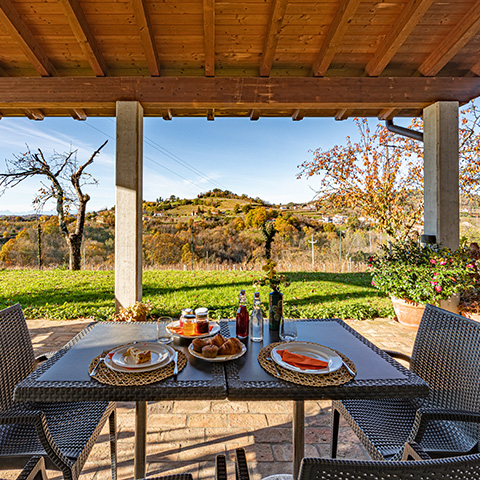
Fancy a visit to beautiful Collio? The Paraschos agriturismo (working winery with lodgings) offers four comfortable rooms with stunning views over the vineyards and the neighbouring hills. San Floriano del Collio where the winery is located is a 90-minute drive from Venice and 45 minutes from Trieste. “Orange wine tourism is growing very fast, and we get visits from natural wine lovers and also those curious to learn more about the wines,” says Alexis. “Two years ago, before the pandemic, we were visited by people of 22 different nationalities. It was fantastic.”
Sozietá Agricola Paraschos
PARASCHOS WINERY & GUESTROOMS
Bucuie 13/a
34070 San Floriano del Collio (GO)
ITALY
+39 328 2645280
info@paraschos.it
www.paraschos.it
The Paraschos Portfolio: top wines
AMPHOREUS MALVASIA
Malvasia Istriana old vines fermented for 12 months in amphorae from Crete followed by 12 months in bottles. No additives.
PARASCHOS MERLOT
Vines grafted from 80-year- old vines on gravel, clay and marl soils. Fermented 28 days on skins in Slavonian vats, followed by 24 months ageing in barrel and tonneaux.
PARASCHOS KAI
100% Friulano picked early morning to retain aromatics, de-stemmed and macerated in open-topped vats on skins. Light press followed by racking to large Slovanian vats, aged for 2 years on fine lees. No additives, no filtration.
NOT PINOT GRIGIO 2018 “VOL. 1”
Pinot Grigio is macerated on skins for 7 days, which yields a deep amber/pink colour. The light press followed by racking to large Slavonian vats for one year on fine lees with batonnage in the first month. No additives, no filtration.
NOT PINOT GRIGIO 2018 “VOL. 2”
Pinot Grigio made as Vol1, with 2 years ageing on fine lees. Both ‘Not’ from different vineyards, with South & North-east aspects.
PARASCHOS ORANGE ONE
Alexis describes this as ‘the true white of Gorizia’, a blend of Ribolla Gialla 50%, Malvasia and Friulano from clay-marl soils. Fully ripe grapes harvested and macerated – extensively on skins with manual punch-down. Fermented in oak vats with skins, aged in large oak for 2 years. No additives, no filtration.
PARASCHOS PONKA
A blend Chardonnay, Sauvignon Blanc, Friulano, Ribolla Gialla, Picolit, Verduzzo, Pinot Bianco. The grapes are hand-harvested parcel by parcel over 3-4 weeks for ripe fruit. Oak fermentation with skins, maturation in large oak for a minimum 24 months. No SO2, no filtration.
Also: Paraschos Ribolla (100% Ribolla Gialla) and Skala (100% Merlot), Paraschos Pinot Noir (25 year old Pinot Noir vines grown on blue marl)
Keen to buy Paraschos wines?
Contact:
Europe: info@paraschos.it

You might also like